
Top 10 Profitable Franchise Businesses in India 2026
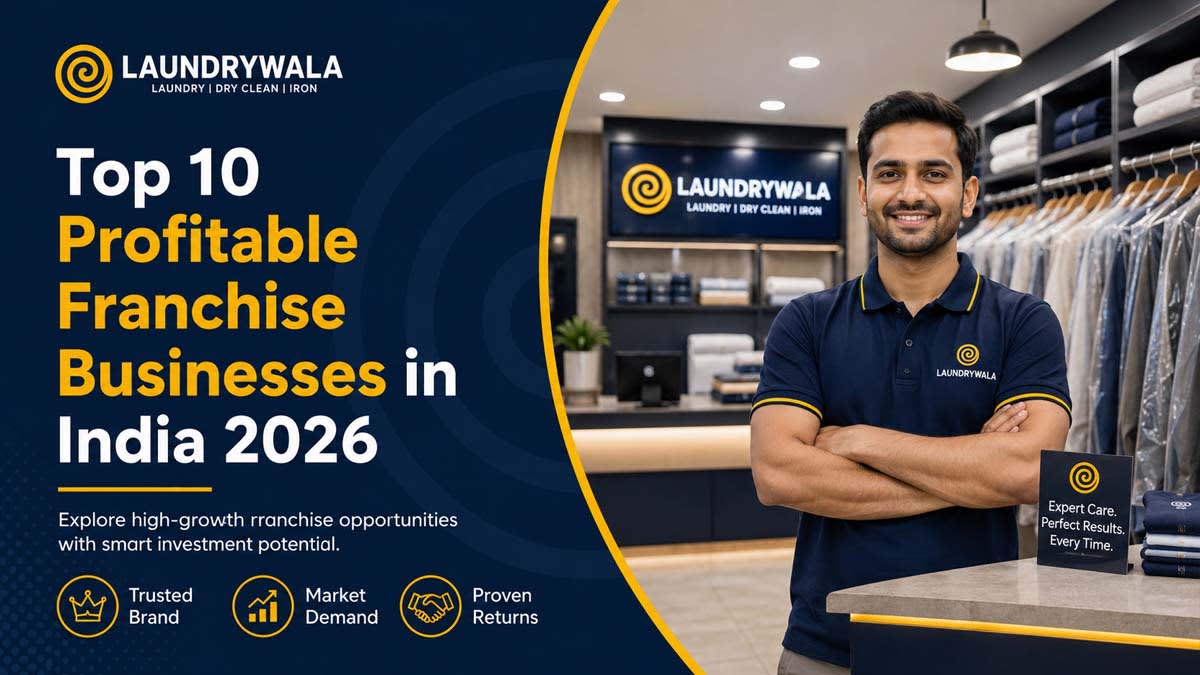
Starting a profitable franchise business in India can be an attractive option for entrepreneurs who want to enter business with an established brand, operating system, training structure and tested business model. A franchise gives you the advantage of starting with a brand name, defined processes and operational support instead of building everything from zero.
However, the most profitable franchise is not always the one that advertises the highest return on investment. Profitability depends on many practical factors: total investment, city demand, rent, staff cost, working capital, repeat customers, local competition and how well the outlet is managed every day.
In 2026, entrepreneurs in India can explore franchise opportunities across laundry and dry cleaning, food and beverage, education, logistics, retail, healthcare, baby and kids retail, fitness, beauty and wellness, and travel services. The right opportunity depends on your budget, location and preferred level of involvement.
This guide compares 10 profitable franchise business opportunities in India, explains what makes each model attractive and shows what investors should verify before putting money into any franchise.
Important: Investment, sales, ROI, profit and break-even figures are projections or estimates unless supported by audited outlet-level performance. No franchise business can guarantee profitability.
What Makes a Franchise Business Profitable in India?
A profitable franchise combines customer demand, manageable operating cost and repeat revenue. Brand popularity alone is not enough. A business may generate good sales but still deliver weak profit if rent, staff cost, inventory, wastage, royalty or customer acquisition expenses are too high.
Before choosing any franchise business in India, investors should look at the fundamentals.
Recurring Customer Demand
Businesses that customers need repeatedly can create more predictable revenue than businesses dependent mainly on occasional purchases. Laundry, salon services, food, education, fitness, logistics and healthcare can all create repeat customer relationships when quality and service remain consistent.
For example, clothes need regular washing, ironing and dry cleaning. This makes the laundry and dry cleaning franchise category interesting for entrepreneurs who want a service business with recurring demand.
Total Investment
Do not compare franchise opportunities only by franchise fee. The actual investment may include franchise fee, machines, store interiors, security deposit, rent, licences, marketing, software, staff recruitment, training and working capital.
A franchise with a lower fee may still become expensive if rent, equipment or operating cost is high. Similarly, a slightly higher investment may be more practical if the brand provides stronger setup support, technology and operating systems.
Operating Costs
Rent, salaries, utilities, consumables, logistics, maintenance and marketing directly affect net profit. A smaller outlet in the right residential location can sometimes perform better than a larger outlet with very high fixed expenses.
For service-based businesses like laundry, operating discipline is very important. Sorting, tagging, stain treatment, washing, pressing, packing and delivery must be handled properly to keep customers satisfied.
Brand and Operational Support
A good franchisor should provide more than a logo. Look for support in site selection, store design, staff training, SOPs, technology, billing, CRM, marketing, customer management, launch assistance and ongoing operations.
Laundrywala, for example, positions its franchise model around store setup support, training, technology, billing, CRM, marketing and doorstep service operations. Investors should still verify the details directly before investing.
Location
Location should match the business model. A preschool needs family-heavy residential catchments. A food outlet may depend on footfall and delivery demand. A laundry business works well around residential societies, apartments, working professionals, hostels, PGs and mixed residential-commercial areas.
Before finalising any franchise location, check the local customer profile, rent, competition, accessibility and delivery radius.
Scalability
A franchise business becomes more attractive when it can grow beyond one outlet. Territory expansion, multiple outlets, B2B customers, delivery-based orders and technology-enabled operations can create additional growth opportunities.
Top 10 Profitable Franchise Business Opportunities in India
There is no single franchise category that is automatically the most profitable. Investors should compare industries based on capital requirement, repeat demand, operating complexity and their own management ability.
Here are 10 franchise categories worth evaluating in 2026.
1. Laundry and Dry Cleaning Franchise
A laundry and dry cleaning franchise can be attractive because clothes and household fabrics require regular care. Unlike product-based businesses where customers may buy occasionally, laundry businesses can generate repeat orders from the same household.
A professional laundry franchise can serve working professionals, families, students, apartment residents, offices and selected commercial customers. Services may include wash and fold, wash and iron, dry cleaning, steam ironing, stain treatment, shoe cleaning, curtain cleaning, carpet cleaning, sofa cleaning and premium garment care.
The combination of regular laundry and higher-value garment-care services creates multiple revenue opportunities from the same customer base. A customer may start with regular laundry, later use dry cleaning services for premium garments, and also book shoe cleaning, curtain cleaning or carpet cleaning when needed.
Why Laundry Franchises Can Work Well
Laundry franchises can work well because they combine repeat demand, doorstep convenience and multiple service categories. Customers need garment care throughout the year. One household may need laundry, dry cleaning, ironing, shoe care and home-fabric cleaning.
Another advantage is limited inventory risk. Unlike product-heavy retail businesses, laundry operators do not need to stock large quantities of merchandise. The business risk is more focused on service quality, timely delivery, customer acquisition and operational control.
Doorstep pickup and delivery can expand the serviceable area beyond walk-in customers. This is useful in cities where customers prefer convenience and online booking. Laundrywala’s laundry services include professional laundry care for daily garments and related service needs.
Operational discipline is still critical. Garment tagging, sorting, stain treatment, quality checking, packaging and delivery management directly affect customer retention.
2. Food and Beverage Franchise
Food and beverage is one of India’s most visible franchise categories because customers buy food frequently. QSRs, cafés, bakeries, beverage kiosks, ice-cream outlets, snack counters and cloud kitchens all fall under this category.
The food sector has strong demand, and India’s food processing ecosystem continues to be supported by consumer demand and industry activity. IBEF notes that India’s food processing sector presents several opportunities and is recognised as a priority industry under Make in India.
However, strong revenue does not automatically mean strong profit. Food businesses must control rent, food cost, staff salaries, utilities, aggregator commissions, wastage and inventory. A food franchise can perform well in the right location, but it can also become operationally demanding.
First-time entrepreneurs should carefully evaluate food cost, daily operations, competition and break-even before investing.
3. Education and Preschool Franchise
Education and preschool franchises can work well in residential areas with young families. Instead of relying only on daily transactions, this business depends on admissions, monthly or term fees, parent trust and student retention.
Success depends on safety, teacher quality, curriculum delivery, infrastructure, parent communication and local reputation. A recognised brand may help generate enquiries, but parents ultimately evaluate the quality of care, education and environment.
The challenge is that many education formats require larger space, trained staff and strict compliance with local rules. Investors should check area demographics and speak to existing franchisees before investing.
4. Logistics and Courier Franchise
Logistics and courier franchises can benefit from ecommerce, local business shipments, document delivery and the growing need for parcel movement. India’s ecommerce market and logistics ecosystem continue to expand with digital payments, online shopping and last-mile delivery demand.
Possible customers include local retailers, online sellers, SMEs, offices, manufacturers and individual consumers. A logistics franchise becomes more interesting when the operator builds recurring B2B accounts rather than depending only on walk-in customers.
Important factors include territory, shipment volume, pickup efficiency, delivery network, service reliability, commercial density and technology support.
5. Retail and Eyewear Franchise
Retail franchises allow entrepreneurs to sell established products with recognised branding, predefined merchandising standards and supply-chain support. Categories may include eyewear, apparel, accessories, electronics, cosmetics, footwear and lifestyle products.
India’s retail sector continues to see consumer and investment activity, but retail success depends heavily on store location, product demand, inventory turnover, margins, rent and staff productivity.
Inventory is the biggest factor to check. A retail outlet may show good sales while still locking capital in slow-moving stock. Investors should understand who owns inventory, how unsold merchandise is handled and what gross margin remains after expenses.
6. Healthcare and Diagnostic Franchise
Healthcare and diagnostic franchise opportunities may include collection centres, clinics, pharmacies and specialised wellness formats. Demand can be recurring, and the healthcare sector in India continues to grow with diagnostics, digital health and specialised care.
However, healthcare is not an ordinary retail category. It requires greater attention to professional qualifications, compliance, service standards, licences and quality protocols.
Investors should verify regulatory requirements, qualified staff needs, equipment responsibility, testing standards, territory rights and revenue-sharing structure. Healthcare opportunities should be evaluated as regulated service businesses, not just commercial investments.
7. Baby and Kids Retail Franchise
Baby and kids retail can serve demand for clothing, toys, accessories, footwear and daily childcare products. The customer base is specific: parents and families with young children.
The advantage is focused demand. The challenge is inventory. Different age groups, sizes, seasons and product categories create many SKUs, which can increase working capital requirements.
Investors should check the number of young families in the catchment, store size, inventory requirement, stock rotation, online competition, local buying power and rent.
This category may suit entrepreneurs who are comfortable with organised retail and inventory management.
8. Fitness and Gym Franchise
Fitness franchises usually run on membership plans, personal training, group classes and fitness programmes. The model can create recurring revenue if customer retention is strong.
The main challenge is fixed cost. Gym businesses may require heavy investment in equipment, interiors, rent, electricity, maintenance and staff. Profitability depends not only on selling memberships but also on keeping members active and reducing churn.
Before investing, calculate membership capacity, monthly break-even, trainer cost, equipment maintenance and local competition. A gym franchise can be attractive, but it requires strong operations and continuous customer engagement.
9. Beauty, Salon and Wellness Franchise
Beauty, salon and wellness franchises benefit from repeat customer demand. Customers may return regularly for haircuts, grooming, skincare, styling and related services. India’s salon and beauty market is influenced by rising grooming awareness, digital bookings, premium services and demand beyond only major metros.
The biggest dependency is skilled manpower. A salon can have a strong brand and good location but still struggle if experienced staff leave frequently or service quality is inconsistent.
Evaluate stylist recruitment, staff retention, training, product cost, appointment utilisation, rent and local competition before investing.
10. Travel Agency Franchise
Travel agency franchises can earn revenue from holiday packages, hotels, flights, visas, insurance and customised travel planning. This business may require less physical infrastructure than restaurants, gyms or large retail formats.
However, the category faces strong online competition. Customers can compare flights, hotels and packages easily, so a travel franchise must offer trust, personal service, destination knowledge and strong follow-up.
This model may suit entrepreneurs with strong sales skills, local networking ability and customer-service experience.
Comparison of Franchise Industries in India
| Franchise Industry | Repeat Demand | Capital Intensity | Operating Complexity | Inventory Risk | Scalability |
|---|---|---|---|---|---|
| Laundry & Dry Cleaning | High | Medium | Medium | Low | High |
| Food & Beverage | High | Medium–High | High | High | High |
| Education/Preschool | High | Medium–High | Medium | Low | Medium–High |
| Logistics & Courier | Medium–High | Low–Medium | Medium | Low | High |
| Retail & Eyewear | Medium | Medium–High | Medium | High | High |
| Healthcare/Diagnostics | Medium–High | Varies | High | Varies | Medium–High |
| Baby & Kids Retail | Medium | Medium–High | Medium | High | Medium–High |
| Fitness/Gym | High if retained | High | Medium–High | Low | High |
| Beauty & Wellness | High | Medium–High | High | Medium | High |
| Travel Agency | Medium | Low–Medium | Medium | Low | Medium–High |
This comparison is directional, not a guarantee of financial performance. Actual results depend on brand, city, format, rent, customer demand and operator execution.
Why Laundry and Dry Cleaning Can Be a Strong Franchise Opportunity
Laundry and dry cleaning deserve special attention because the model combines recurring household demand, multiple services and relatively low inventory exposure.
Customers do not buy new clothes every week, but they repeatedly need existing garments cleaned, pressed and maintained. A single customer can create revenue across several needs: daily wear, office wear, premium garments, footwear and home fabrics.
This increases customer lifetime value because the business can serve many garment-care needs instead of constantly depending only on new customers.
Doorstep pickup and delivery can also reduce dependence on walk-in footfall. Customers can book from home, and the outlet can serve nearby apartments, societies, offices and residential clusters.
Laundrywala Franchise Business Model
Laundrywala positions its franchise as a technology-enabled laundry and dry-cleaning business supported by store setup, training and operational assistance.
According to Laundrywala’s franchise information, the model mentions a total investment range of approximately ₹12 to ₹25 lakh, area requirement of around 250 to 600 sq. ft. and an expected ROI period of 12 to 16 months. These are projected figures and actual results depend on location, sales, operating cost and outlet performance.
Multiple Garment-Care Services
Laundrywala’s service model can include laundry, dry cleaning, steam ironing, shoe cleaning and selected home-fabric cleaning services. This allows a franchise operator to serve different requirements from the same local customer base.
For example, one customer may need weekly wash and iron, occasional dry cleaning, shoe cleaning before an event and curtain cleaning during seasonal home cleaning.
Doorstep Pickup and Delivery
Laundrywala supports doorstep pickup and delivery, which is important in modern service businesses. Customers prefer convenience, especially in apartment-heavy and working-professional catchments.
A pickup-and-delivery model can expand the effective service area beyond customers who physically walk past the outlet. Franchise owners can also build repeat orders through local society campaigns, WhatsApp support and regular customer follow-ups.
Technology Support
Technology is useful in laundry because every garment goes through multiple stages. Order management, billing, CRM and app-based systems can help track customer details, order status and repeat business.
A technology-enabled process also helps reduce confusion in garment counting, order updates and customer communication.
Training and Operational Support
Laundry operations require consistency. Garments have different fabrics, colours, stains and care instructions. Sorting, tagging, stain treatment and finishing must follow a process.
Laundrywala’s franchise material highlights setup assistance, staff training, app-based order management, billing, CRM and marketing support. Investors should still verify the exact support structure directly with the franchise team before signing.
To discuss franchise availability, investors can visit the Laundrywala franchise page or contact the brand through the official website.
Which Franchise Business Is Best for First-Time Entrepreneurs?
The best franchise for a first-time entrepreneur is usually one with clear SOPs, manageable capital requirement, repeat demand and strong franchisor support.
New investors should avoid choosing a business only because an advertisement promises high ROI. Instead, ask practical questions:
- Do customers need this product or service regularly?
- Can I understand and supervise the operations?
- How much working capital will I need?
- Is demand proven in my location?
- How many employees will be required?
- What happens if sales are lower than expected?
- What support does the franchisor provide after opening?
Service businesses with relatively low inventory exposure can be interesting for first-time entrepreneurs because less capital is locked in unsold products. Laundry, logistics, beauty services and selected travel models may fall into this category depending on the brand and format.
How to Choose a Profitable Franchise Business in India
Choosing a franchise should be treated like an investment decision, not a branding decision. Before signing an agreement, calculate the economics of the exact outlet you plan to open.
Step 1: Fix Your Total Budget
Decide how much capital you can invest without putting your personal finances under pressure. Keep part of the budget aside for working capital.
Step 2: Study Local Demand
Do not assume national brand demand automatically exists in your locality. Check population density, customer profile, apartments, offices, student population, competition, commercial rent and spending behaviour.
For a laundry franchise, residential societies, PGs, hostels, office clusters and premium garment users are important demand signals.
Step 3: Estimate Revenue Conservatively
Do not build your business plan only on the franchisor’s best-case sales projection. Prepare conservative, expected and optimistic scenarios.
If the business works only in the optimistic case, the investment needs further review.
Step 4: Calculate Monthly Expenses
Include rent, salaries, electricity, water, consumables, logistics, maintenance, marketing, software, royalty, taxes and repairs. Only then calculate expected operating profit.
Step 5: Speak With Existing Franchisees
This is one of the most useful due-diligence steps. Ask existing partners about setup cost, time to launch, monthly operating expenses, franchisor responsiveness, marketing support, customer acquisition and profitability timeline.
Step 6: Review the Franchise Agreement
Pay attention to territory protection, franchise term, renewal, royalty, marketing fees, exit terms, procurement rules, performance obligations and termination conditions. Take legal advice before signing a substantial commercial agreement.
Hidden Costs to Check Before Buying a Franchise
Franchise comparison articles often focus on franchise fee, but hidden and secondary costs can make a big difference.
Security Deposit and Rent
Premium locations may require several months of security deposit before operations begin.
Interiors and Civil Work
Electrical work, plumbing, signage, counters, furniture and store modifications can increase setup expenses.
Machinery and Maintenance
Equipment-based businesses need installation, servicing, spare parts and eventual replacement.
Staff
Recruitment is only the beginning. Include salaries, incentives, uniforms, training and employee turnover.
Launch Marketing
Local awareness is essential even when the parent brand is established.
Delivery Cost
For doorstep businesses, fuel, riders, vehicles, maintenance and routing must be included in unit economics.
Working Capital
You should have enough cash to run the outlet while the business is still building its customer base.
Franchise ROI vs Profit: Understand the Difference
ROI, revenue, profit and break-even are different financial concepts.
Revenue is the money customers pay the business. Gross profit is revenue after direct service or product costs. Net profit is what remains after operating expenses. Break-even may refer to monthly cost recovery or total investment recovery, depending on how the term is used. ROI measures return compared to capital invested.
Before accepting any advertised ROI figure, ask how it was calculated. Check whether the projection includes owner salary, rent, staff cost, royalty, marketing, depreciation, financing cost and taxes.
If major expenses are excluded, the advertised ROI may not represent the amount that actually reaches the franchise owner.
Franchise vs Starting an Independent Business
| Factor | Franchise | Independent Business |
| Brand | Existing identity | Built from scratch |
| SOPs | Usually provided | Must create yourself |
| Training | Usually available | Arrange independently |
| Technology | May be provided | Build or purchase |
| Marketing | Brand support possible | Fully owner-managed |
| Freedom | Lower | Higher |
| Franchise Fee | Usually yes | No |
| Model Testing | Existing model | Owner must validate |
A franchise may suit a first-time entrepreneur who values systems and support. An independent business may suit an experienced operator who wants complete control over pricing, branding and processes.
Neither model automatically guarantees better returns.
Which Franchise Is Best Based on Your Investment Budget?
Investment should be viewed as total capital required, not only franchise fee.
Lower-capital opportunities may include selected courier agencies, compact service formats and travel agency models. Mid-range opportunities may include laundry, selected food formats, beauty businesses and compact retail outlets. Higher-capital opportunities may include large restaurants, premium retail, gyms and larger education formats.
Laundrywala’s current full-service franchise information places the model in the approximate ₹12 to ₹25 lakh investment range, depending on format and location. This can make it relevant for entrepreneurs exploring franchise businesses under ₹25 lakh, subject to local feasibility and financial planning.
Common Mistakes to Avoid When Selecting a Franchise
Many franchise failures begin before the store opens. Avoid choosing a franchise only because of a high ROI claim. Avoid ignoring working capital. Avoid selecting a location only because rent is cheap. Avoid underestimating local competition.
Also avoid investing without talking to existing franchisees. A sales presentation can explain the opportunity, but existing partners can often share practical details about daily operations, customer acquisition, support and profitability timeline.
Most importantly, do not sign an agreement without understanding your financial and contractual obligations.
Questions to Ask a Franchisor Before Investing
Before investing in any franchise business in India, ask the franchisor:
- What is the complete investment required?
- What exactly is included in the franchise fee?
- How much working capital should I keep?
- Are there royalty or marketing charges?
- What is the average outlet’s monthly operating cost?
- How was the projected ROI calculated?
- Can I speak with existing franchisees?
- What training will my staff receive?
- Who selects and approves the location?
- Is my territory exclusive?
- What marketing support is provided after launch?
- What happens when the franchise agreement expires?
- What are the exit and termination conditions?
- What additional equipment or upgrades may be required later?
Clear answers to these questions are more useful than a simple promise of profitability.
Which Is the Most Profitable Franchise Business in India?
There is no universally most profitable franchise business in India. The right opportunity depends on investment, city, demand, rent, operating cost, management ability and execution.
Food may produce high transaction volume but can have wastage and intensive operations. Retail benefits from consumer demand but needs inventory. Gyms offer memberships but require high fixed investment. Logistics can scale but depends on shipment volume.
Laundry and dry cleaning deserve consideration because they combine recurring household demand, several service categories, limited merchandise inventory and the potential for doorstep pickup and delivery.
For entrepreneurs evaluating Laundrywala specifically, the decision should still be based on local market research, direct discussion with the franchise team and a detailed outlet-level financial model.
Conclusion
A profitable franchise business in India is not chosen only by looking at brand name or advertised ROI. It is selected by studying demand, investment, location, operating cost, support, scalability and risk.
Laundry and dry cleaning can be a strong category for entrepreneurs who want a repeat-demand service business with multiple revenue streams and limited inventory exposure. Laundrywala adds a structured franchise model with laundry, dry cleaning, technology support, training, marketing assistance and doorstep service capability.
If you are planning to start a franchise business in India in 2026, compare multiple sectors carefully, speak with existing franchisees and calculate realistic numbers before investing.
To explore Laundrywala franchise availability in your city, visit the official Laundrywala franchise page and connect with the franchise team for details.
Laundrywala FAQs
Find answers to commonly asked questions about our services, processes, and how we deliver quality across India.


